🍎 Apple’s Privacy Lab: Math, Magic, or Marketing?
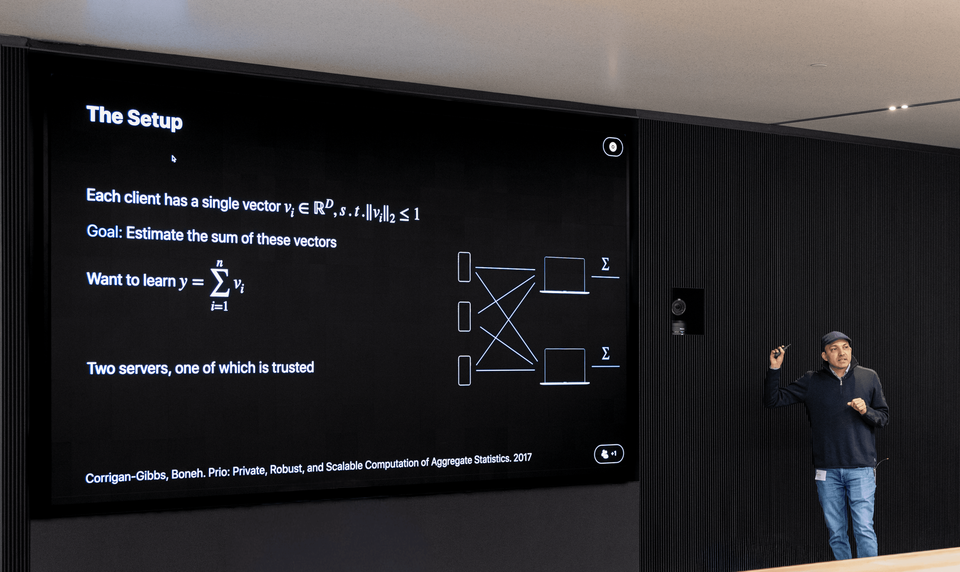
We’ve spent a lot of time talking about "Local AI" as the gold standard for privacy. But let's be honest: building an AI that is both incredibly smart and totally private is one of the hardest problems in computer science right now.
That’s why we were curious when Apple dropped their update on the Workshop on Privacy-Preserving Machine Learning (PPML).
Now, if you read that page, it looks like a giant list of academic papers and "SDE Perspectives." It’s very Academic Paper Core. But if you strip away the jargon, Apple is essentially showing us the blueprints for how they plan to keep your data safe while making Siri (hopefully) less annoying.
Here is what's actually happening in Apple’s privacy lab. 🛡️
🧐 The Big Problem: "The Memorization Glitch"
One of the most interesting parts of this workshop focuses on Memorization.
Ever wonder why some AI bots accidentally leak a phone number or a private address that was in their training data? That's because LLMs have a habit of "memorizing" specific snippets of data instead of just learning general patterns.
Apple is diving deep into things like "Finding NeMo" (localizing the neurons responsible for memorization) and ways to prune training data so the AI doesn't accidentally become a digital scrapbook of everyone's secrets. In short: they're trying to stop the bot from "remembering" you specifically, while still remembering how to be helpful.
🔐 The Secret Sauce: Differential Privacy & Homomorphic Encryption
Apple mentions two big concepts that sound like sci-fi but are actually just heavy math:
- Differential Privacy: This is essentially adding "noise" to data. Imagine if you wanted to know the average height of people in a room, but didn't want anyone to know your exact height. Differential privacy adds a bit of random static so the overall trend is accurate, but individual identities are blurred.
- Homomorphic Encryption: This is the Holy Grail of privacy. It allows a computer to perform calculations on data while it is still encrypted.
Think about that for a second: usually, to process your prompt, an AI has to "unlock" it (decrypt it), read it, and then respond. Homomorphic encryption means the AI can technically work on the puzzle without ever actually seeing the picture. 🤯
📱 Local First, Cloud Second
The workshop also touches on Memory-Efficient Backpropagation for mobile devices. This is fancy talk for: "We are trying to make it possible to fine-tune and train AI directly on your iPhone without it overheating or crashing."
This aligns perfectly with our "On-Device" philosophy. The more Apple can move the "learning" part of the AI onto your actual hardware, the less they have to rely on servers—and the fewer opportunities there are for a data leak.
🏁 The Verdict: Should we trust it?
Apple has always positioned itself as the "Privacy Company," but they are still a trillion-dollar corporation. However, the fact that they are hosting workshops with external researchers and publishing papers on Differential Privacy and Memorization Mitigation is a good sign.
It shows they aren't just relying on a "Trust us, we're the good guys" marketing campaign—they are actually investing in the math required to make privacy a technical reality.
The Safer Prompts Take:
Apple’s research is impressive, but remember: Research is not Implementation.
Just because they have a paper on how to stop AI memorization doesn't mean every single feature on your phone is currently using it. Stay curious, stay skeptical, and keep your prompts locked. ✌️